
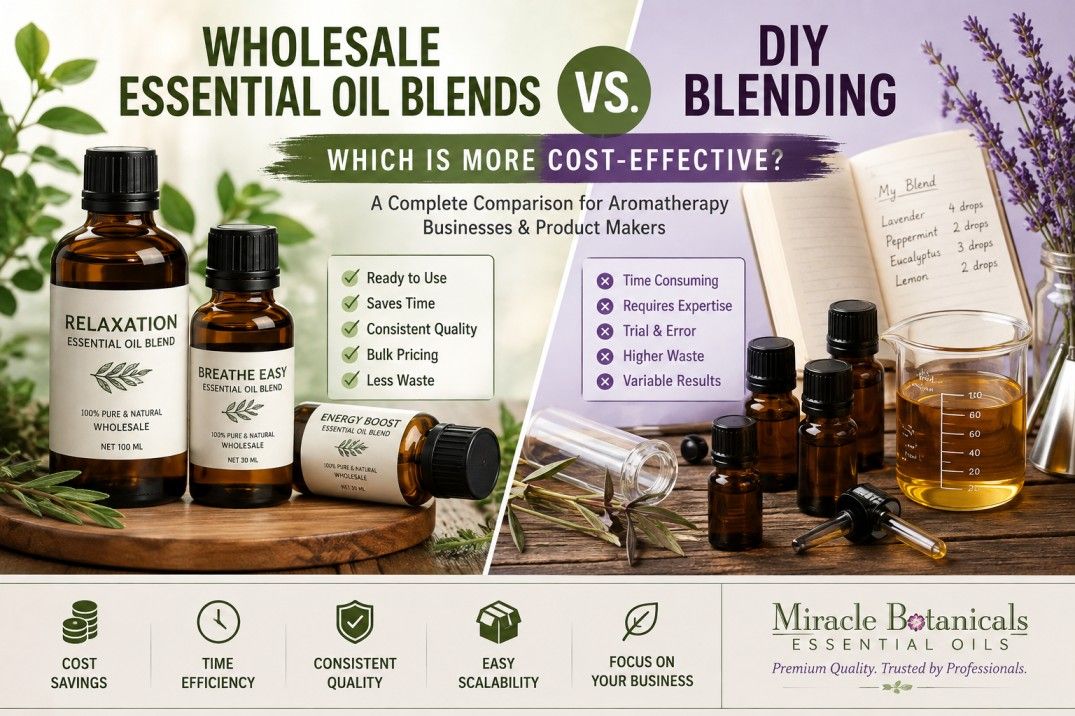
For businesses working with aromatherapy, skincare, personal care, candles, or natural wellness products, choosing between ready-made blends and creating formulas in-house can have a major impact on overall costs. At first glance, making your own blends may seem cheaper because you purchase individual oils and control the recipe. However, the real cost includes much more than the price of raw materials.
Wholesale essential oil blends can provide a practical alternative for businesses that want consistent formulations without investing significant time and resources into blending, testing, and production. Comparing both approaches across material costs, labor, consistency, waste, scalability, and convenience can help businesses determine which option delivers better long-term value.
What Are Wholesale Essential Oil Blends?
Wholesale essential oil blends are pre-formulated combinations of essential oils purchased in larger quantities for business or production purposes. Instead of sourcing several individual oils and developing a formula from scratch, businesses can purchase a blend designed for a particular aromatic profile or product concept.
These bulk essential oil blends can be useful for retailers, spas, manufacturers, private-label businesses, and product developers that need repeatable formulations. They may also reduce the number of individual ingredients a business needs to store and manage.
For example, a company developing an aromatherapy product may need several different oils to create a balanced aroma. Purchasing a ready-made essential oil blend can simplify the sourcing process and reduce the number of separate ingredients required.
What Is DIY Essential Oil Blending?
DIY blending involves purchasing individual essential oils and combining them according to a specific formula. Businesses can develop their own ratios, adjust aroma profiles, and create unique formulations.
This approach offers a high level of creative control. A formulator can experiment with different combinations until achieving the desired scent profile. However, experimentation can also create additional costs through trial batches, unused ingredients, formulation time, and production waste.
For businesses producing products at scale, those hidden expenses can become significant.
Cost of Ingredients
The first comparison most buyers make is the cost of ingredients.
With DIY blending, you need to purchase each individual essential oil used in the formula. If a blend contains five or six oils, you must source and maintain inventory for all of them.
By contrast, wholesale essential oil blends allow a business to purchase a finished combination rather than buying every component separately. Depending on the supplier, volume, and formulation, this can simplify purchasing and potentially reduce inventory-related expenses.
However, price per unit should not be the only factor. Businesses should calculate the complete cost per finished product, including sourcing, shipping, storage, labor, testing, and waste.
Labor and Production Time
Time is another major factor.
DIY blending requires measuring individual oils, preparing equipment, creating batches, documenting formulas, cleaning equipment, and maintaining consistent production procedures. Larger operations may also require additional quality-control steps.
A pre-formulated product can reduce many of these tasks. Wholesale aromatherapy blends can arrive ready for incorporation into an appropriate product formulation, depending on the supplier's specifications and intended application.
For a small business owner handling production personally, saving even a few hours each week can make a meaningful difference.
Consistency Between Batches
Consistency is particularly important for businesses selling products under an established brand.
When DIY formulas are produced manually, small differences in measurements or raw-material characteristics can affect the final aroma. Accurate scales, documented procedures, trained staff, and quality-control processes can reduce these variations, but they also require investment.
Using a consistent pre-blended essential oil formula can simplify repeat production. Businesses should still verify supplier documentation, specifications, batch information, and quality standards before incorporating any blend into commercial products.
Waste and Failed Batches
DIY formulation can involve experimentation. While testing is valuable during product development, not every trial formula becomes a sellable product.
Unused oils, unsuccessful batches, excess packaging materials, and expired inventory can increase the true cost of DIY production.
A carefully selected bulk aromatherapy blend can reduce the number of separate ingredients that need to be purchased and stored. This may be particularly useful for businesses with limited storage capacity or relatively predictable production requirements.
Flexibility and Customization
DIY blending has one clear advantage: customization.
If your business needs a completely distinctive aroma, creating your own formula allows you to control individual ingredients and their proportions. This can be valuable for brands developing signature products.
Ready-made blends provide less control over the exact formula. Therefore, businesses should consider whether customization or operational efficiency is the higher priority.
For companies that require frequent formula changes, DIY may provide greater flexibility. For businesses producing standardized products, a reliable ready-made option may be more efficient.
Scalability for Growing Businesses
A formula that works for 50 units may not be equally efficient when production reaches 5,000 units.
As production grows, sourcing multiple individual oils, maintaining inventory, measuring ingredients, and managing production records become increasingly complex.
Wholesale essential oil blends can simplify procurement because fewer individual ingredients may need to be managed. This can make production planning easier and potentially reduce operational complexity.
Still, businesses should compare supplier minimum-order quantities, lead times, pricing tiers, shelf-life information, and documentation before committing to large-volume purchasing.
Which Option Is More Cost-Effective?
There is no universal answer.
DIY blending may be more cost-effective when:
- You produce small quantities.
- You already have formulation expertise.
- You need highly customized formulas.
- You have established equipment and quality-control procedures.
- You already maintain inventory of the required individual oils.
Ready-made blending may be more economical when:
- You produce consistently at higher volumes.
- Labor costs are significant.
- You want repeatable aroma profiles.
- Storage space is limited.
- You want to simplify procurement.
- You prefer to spend less time on formulation and batching.
The best approach is to calculate total cost of ownership, rather than comparing only the purchase price of the oils.
A Simple Cost Comparison
Imagine a business needs a blend containing several individual oils.
With DIY production, the calculation could include:
Individual oils + measuring equipment + labor + testing + storage + waste + packaging = total DIY cost
For a ready-made option, the calculation may look like:
Blend purchase price + shipping + storage + required testing + labor for final production = total ready-made cost
The lower ingredient price is not necessarily the lower overall cost. A slightly more expensive raw material can sometimes be more economical if it substantially reduces labor, waste, or inventory requirements.
Quality Should Remain Part of the Calculation
Cost should never be considered independently from quality.
Businesses should review supplier transparency, ingredient information, batch documentation, storage recommendations, and quality-testing practices. A lower-priced blend may not provide the documentation or consistency needed for a commercial product.
When evaluating suppliers such as Miracle Botanicals Essential Oils, businesses can consider sourcing information and product specifications alongside pricing to determine whether a blend fits their operational and quality requirements.
Where Peppermint Blending Fits Into the Discussion
Peppermint is one example of an essential oil that can be incorporated into personal wellness and aromatherapy routines. For additional reading, businesses and consumers may find the article “How Peppermint Essential Oil Fits Into a Natural Wellness Routine” useful for understanding how peppermint oil can be discussed within a broader natural wellness context. Read the peppermint essential oil wellness article
When developing commercial products, however, businesses should distinguish general wellness content from product formulation requirements and follow appropriate safety, labeling, and regulatory practices.
Final Verdict
So, which approach wins on cost?
For highly customized, small-scale formulation, DIY blending can make sense. Businesses with existing equipment, expertise, and ingredient inventory may benefit from maintaining complete control over their formulas.
For businesses prioritizing efficiency, consistency, scalability, and simplified sourcing, wholesale essential oil blends can be a compelling option. The key is to compare the complete production cost rather than looking only at the price of a bottle or kilogram of raw material.
Ultimately, the most cost-effective strategy depends on production volume, labor availability, customization requirements, storage capacity, and supplier pricing. A detailed cost-per-batch calculation can reveal which approach makes the most financial sense for your particular business.
FAQs
1. Are wholesale essential oil blends cheaper than DIY blending?
They can be, particularly when labor, waste, storage, and formulation time are included. The actual savings depend on volume, supplier pricing, and the complexity of the blend.
2. Is DIY essential oil blending better for small businesses?
DIY can be useful for businesses that need customized formulas or produce limited quantities. However, businesses should account for formulation time, equipment, ingredient inventory, and testing.
3. What should businesses consider when buying bulk essential oil blends?
Consider ingredient quality, supplier transparency, batch documentation, minimum order quantities, pricing, lead times, storage requirements, and consistency between batches.
4. Can ready-made blends be customized?
Some suppliers offer custom formulation or private-label services, while others sell fixed formulas. Businesses should check directly with the supplier to determine available customization options.
5. How can a business calculate the true cost of essential oil blending?
Calculate the total expense of ingredients, labor, equipment, testing, storage, shipping, waste, and production time. Then divide the total by the number of finished units produced to determine the approximate cost per unit.